
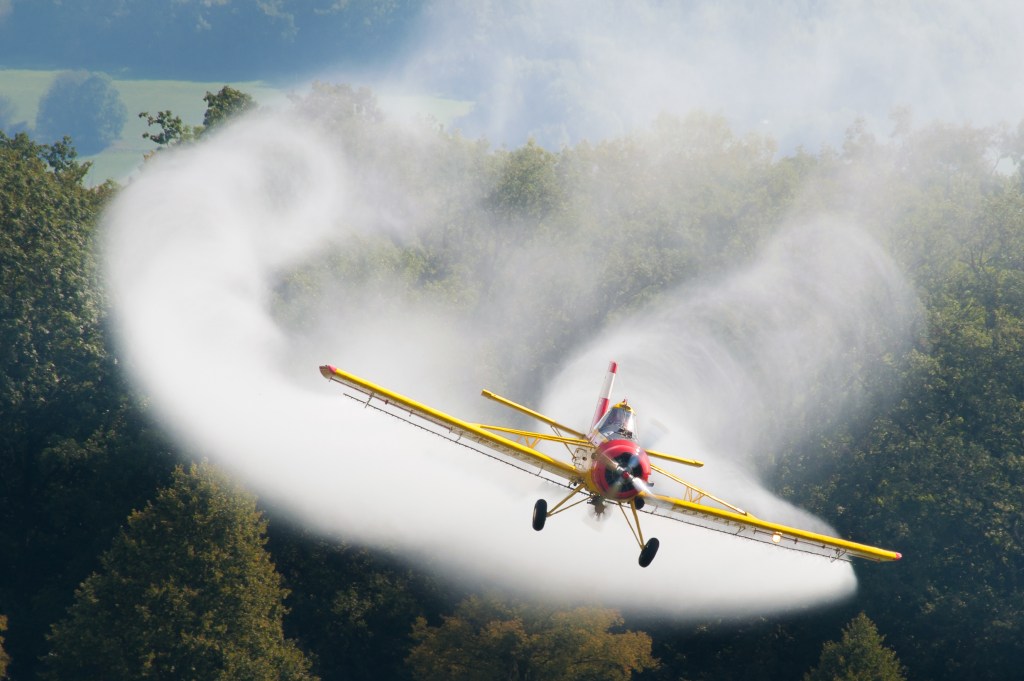
New research is showing that toxic chemicals used in agriculture can persist in the atmosphere and in clouds, resulting in distribution of chemical toxins over inhabited areas where they are prohibited even for agricultural use.
U.S. Right to Know is reporting:
Pesticides banned years ago in the European Union are drifting through the skies and turning up in clouds above France, raising concerns about how long these toxins persist and how far they can travel, with potentially harmful global health impacts, according to a pathbreaking new study.
The research, published this week [Sept. 8] in Environmental Science & Technology, is the first to detect dozens of agricultural chemicals—including insecticides, herbicides, fungicides, and other substances—suspended in cloud water droplets. That means pesticides not only linger in the environment but also move through the atmosphere and fall back to Earth in rain or snow, sometimes at levels exceeding European safe drinking water limits, the research suggests.
The newly published research, by Bianco et al., responds to the recognition that “Pesticide contamination is a growing and alarming concern for both the environment and human health.” It confirms findings that “pesticides undergo extensive long-range atmospheric transport in the gas phase, in aerosols, and, as shown here, in clouds.”
The authors report:
Estimates of pesticides’ quantity in clouds over France, ranging from 6.4 ± 3.2 to 139 ± 75 tons, suggest that their amounts in the cloud aqueous phase are potentially high and that these compounds would affect areas that are not directly impacted by agricultural activities.
In other words, pesticides travel in both gaseous and liquid states, up into the atmosphere and through weather patterns. Clouds, and therefore rain, can also distribute pesticides over wide areas well outside of landscapes directly engaged in agricultural production. The confirmation that pesticides—including some known to be neurotoxins or endocrine disruptors, or to have other toxic effects on human health—can travel long distances through the atmosphere suggests a need for stronger restrictions on their use. It may also inform national policies related to trade and international investment.
According to U.S. Right to Know:
Clouds also act as chemical “reactors.” The study found that they not only transport pollutants but also transform them into other substances. An upcoming study by some of the same researchers shows, for instance, that triphenyl phosphate (TPHP), a toxic chemical used in plastics and flame retardants, turns into other chemicals, including diphenyl phosphate (DPHP), in about 90 minutes in cloud water.
The EU SPRINT Project found wide incidence of toxic pesticides outside of agricultural landscapes, including in “harvested products” or food products intended for human consumption. SPRINT “aims to develop a Global Health Risk Assessment Toolbox to assess impacts of Plant Protection Products (PPPs) on environment and human health and to propose several transition pathways”.

Supply chains are opportunities for improvement across all metrics
The SPRINT Project’s report on Occurrence of pesticide residues in harvested products of various crops from European conventional and organic farming systems:
- counted and measured pesticide residues on 6 types of crop harvested across 10 European countries;
- compared crops from organic farms with crops from conventional farms;
- found crops contained multiple pesticide residues – especially those from conventional farms, including long-banned substances;
- suggested that pesticide residues can be influenced by agricultural practices, with permanent crops tending to have higher levels.
This new research is an important reminder that not all pollution is visible or easily discernible. Some of the banned toxins can have serious negative health consequences, especially for children, in relatively low volume. Persistence and long-distance travel in the atmosphere raises the stakes for public health measures, and reinforces the need for transition strategies, such as those targeted by the SPRINT Project.

To ‘Make America Healthy Again’, require chemicals be proven safe
In the U.S., where endocrine and metabolic health issues are serious drivers of morbidity and mortality, the cost of allowing such toxins to permeate the environment are extreme. One study found endocrine-disrupting chemicals are linked to $340 billion in health costs per year in the United States.
As evidence for the persistence of pesticides and other toxins accumulates, the market imperative for rapid innovation is intensifying. Those businesses that find ways to produce food safely, while reducing the flow of toxins into soil, air, water, and the biosphere, will be favored by governments and investors looking to avoid liability linked to toxic impacts.
